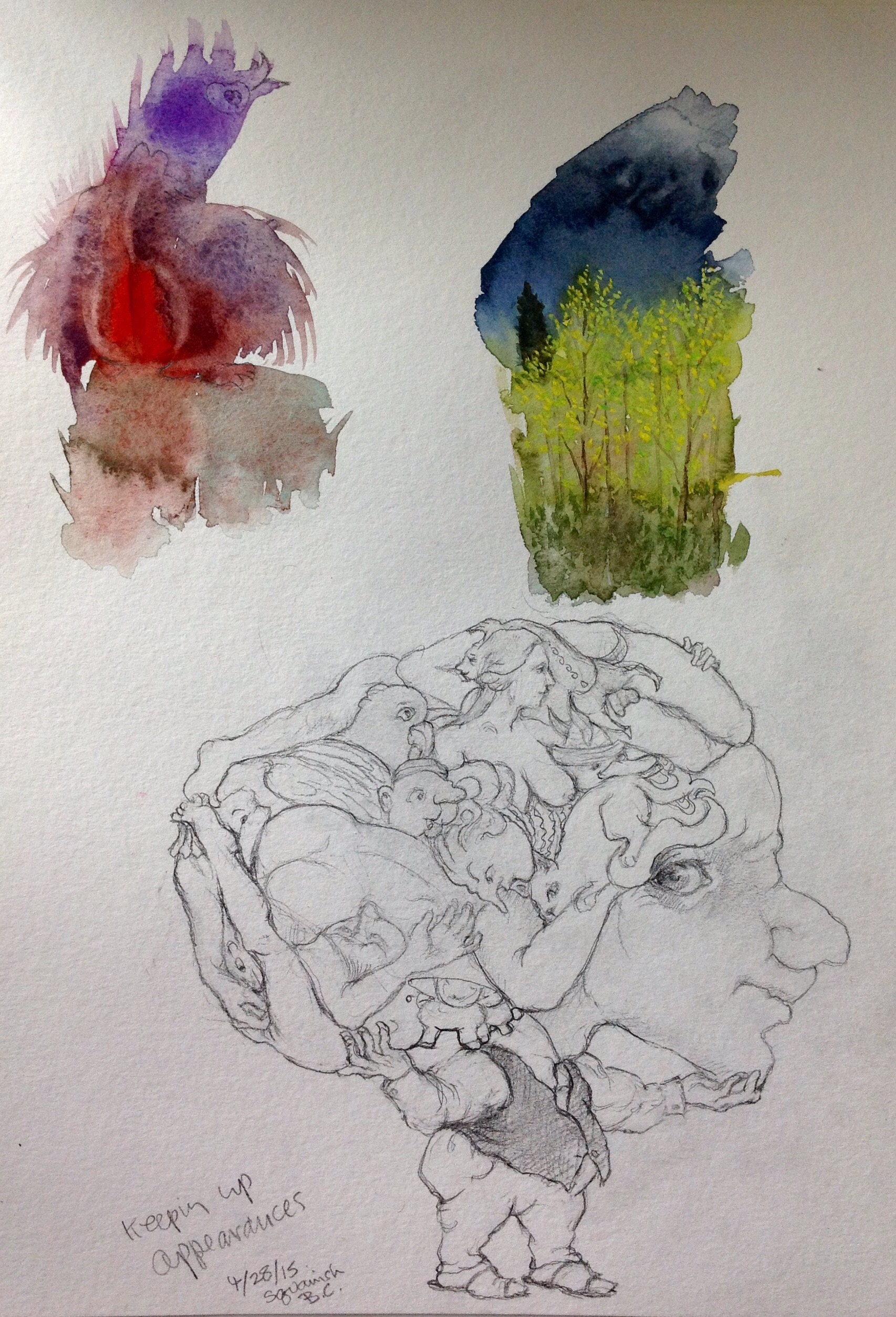
Non-fiction Book Cover Concept Rough
this from the world’s worst blog poster… At least in terms of how often I managed to post! This is just a cover concept rough as the title implies I did and I have other some other thumbnail ideas I am working on at the moment ,too — not included here… Ha!
Apparently, on my iPad I am not able to make the image small enough to post (once it is upright).

clearly…a posting maven, I am not!
An oil doodle sketch…love just fooling around

Another pencil test leads to doodling
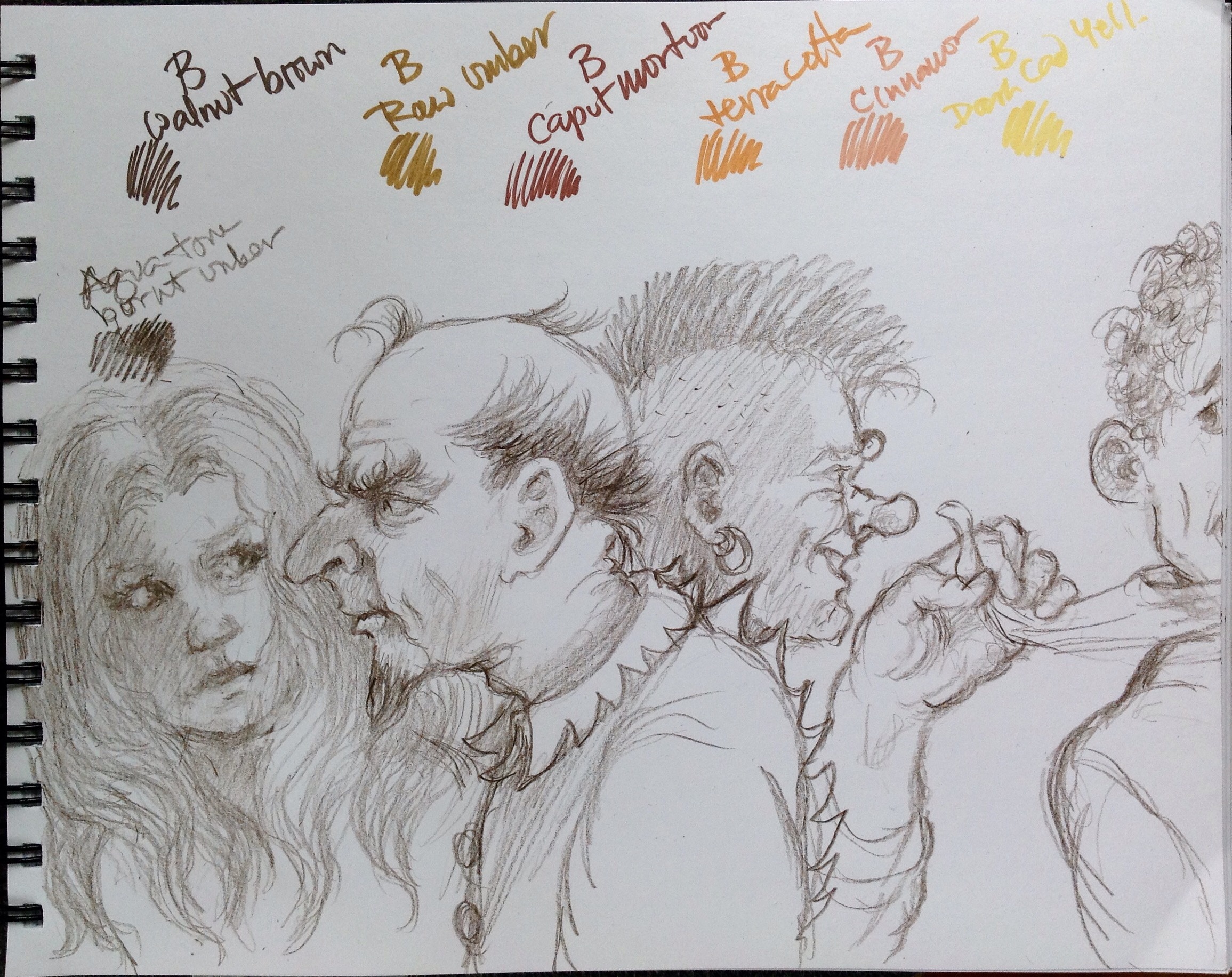
Yesterday’s usual doodling while choosing the tools needed for current work

i’ve caught gold fever
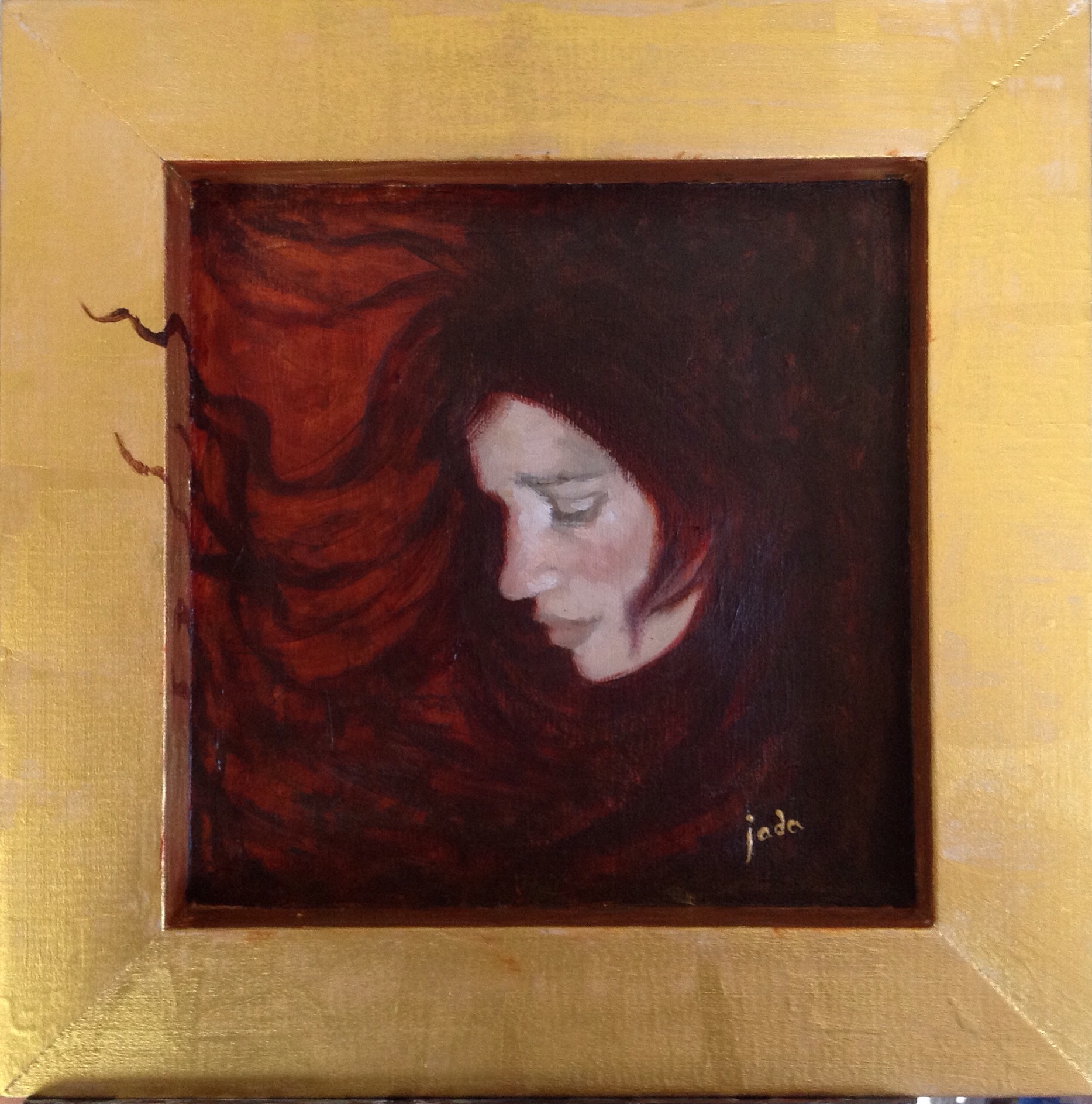
Another little quickie acrylic/oil 10×10″ (7×7″) main-work avoidance piece for a fund raiser
Science Fiction Writers Take a Rosier View..here’s a thought…
Science Fiction Writers Take a Rosier View
By NICK BILTONSEPT. 17, 2014
Well, for some, that is not too far from reality. For decades sci-fi writers have been making bold predictions of what tomorrow might look like. But now writers are starting to realize that in predicting the future, they have actually helped shape it.
For example, we can thank sci-fi authors for first envisioning credit cards, which go all the way back to 1888 when Edward Bellamy wrote about them in his novel “Looking Backward.” Additionally, solar power and radar were envisioned by Hugo Gernsback in his 1911 magazine stories; H.G. Wells anticipated voice mail in 1923; in-ear headphones and large flat-screen TVs were in Ray Bradbury’s 1953 novel, “Fahrenheit 451;” virtual reality was dreamed up by Arthur C. Clarke in 1956; Jules Verne told stories about electronic submarines all the way back in 1870; and Martin Cooper, who created the first mobile phone, said the idea came to him after watching “Star Trek.”
But not all of the predictions have been rosy. We can also thank these writers for contributing to dark advances in technology.
Atomic bombs first appeared in H. G. Wells’s 1914 novel “The World Set Free;” George Orwell aptly predicted — and maybe contributed to — our N.S.A.-like surveillance state in “Nineteen Eighty-Four;” and writers have been envisioning incredibly destructive weapons of all shapes and sizes, including biological warfare, for centuries.
Now a group of visionaries have banded together to offer stories that are more utopian, which they hope will contribute to a more positive future.
This work began in 2011, when Arizona State University’s president, Michael Crow, challenged Neal Stephenson, the author of several sci-fi novels, to stop writing dystopian stories, and offer ideas with a brighter outlook. The concept caught on and last week a group of writers, in collaboration with the university, released “Hieroglyph: Stories and Visions for a Better Future,” which hopes to be a blueprint for these new concepts.
“Sci-fi stories have helped shape technology at crucial points,” said Kathryn Cramer, co-editor of Hieroglyph. “But a lot of the past was dystopian. We’re hoping to show that there are a lot of things we can do better.”
One thing writers are pushing back against in particular is Hollywood’s depiction of the future. You know, where robots roam the earth killing puppies and enslaving humans. Take “Transcendence,” an action film this year starring Johnny Depp, who plays a brilliant scientist who is resurrected as an artificial intelligence program that becomes evil. Or “12 Monkeys,” in which a man-made virus wipes out most of the planet’s population.
“I got into a little bit of a rut thinking that the way to be cool was to be cynical and dark,” Mr. Stephenson said. “I don’t regret that at all. Now I have a license to go out and try something with a different tone.”
Mr. Stephenson’s story in the new collection is about an engineer’s effort to build a 20-kilometer-tall skyscraper. Other tales envision an alternative Internet that is free from N.S.A. snooping and corporate tracking, and is powered by thousands of homemade drones. Another story is about a group of hardware hackers and Burning Man devotees who build an autonomous 3-D printing robot that goes to the moon. A third imagines a future world without border fences.
The stories still offers plenty of drama, death and destruction, but many have a sort of happy ending. Cory Doctorow, a contributor to Hieroglyph,wrote that the stories are not “optimistic or pessimistic about the future. Instead, they are hopeful about it.”
Last week, the editors of the collection took a trip around Silicon Valley, giving talks at big companies, including Google — which is building a bunch of robots that may one day roam the earth, but (one hopes) won’t enslave people — to try to persuade engineers to think differently.
While Mr. Stephenson isn’t so Pollyanna-ish as to think that these sci-fi narratives will make the world a better place, he hopes that they can have a constructive influence. “There’s definitely some kind of a feedback loop between science fiction and technological fact,” he said.
But these negative stories can serve a positive role, too.
Daniel Suarez, author of the popular novel “Daemon,” about a computer program that tries to destroy the world and kill people, said it is the job of science writers to help computer engineers understand how technology can adversely affect humanity. “Science fiction is never about the machines themselves, it’s about humanity’s relationship with those machines,” he said.
Mr. Suarez believes that science fiction can help prevent technology-driven calamities by serving as a warning. “Because people worry about being under the control of dystopian robot overlords, we’re less likely to be in that situation,” he said. “By going through all the different ways that we might end up there, we will figure out all the ways that we might not end up there.”
In other words, we need to imagine the nightmare so it doesn’t become real.
sunday casein work avoidance doodle

Macbeth and his lady wife ..more or less finished…oil on linen 24×36

DELAYING TACTICS which also serve as warm ups
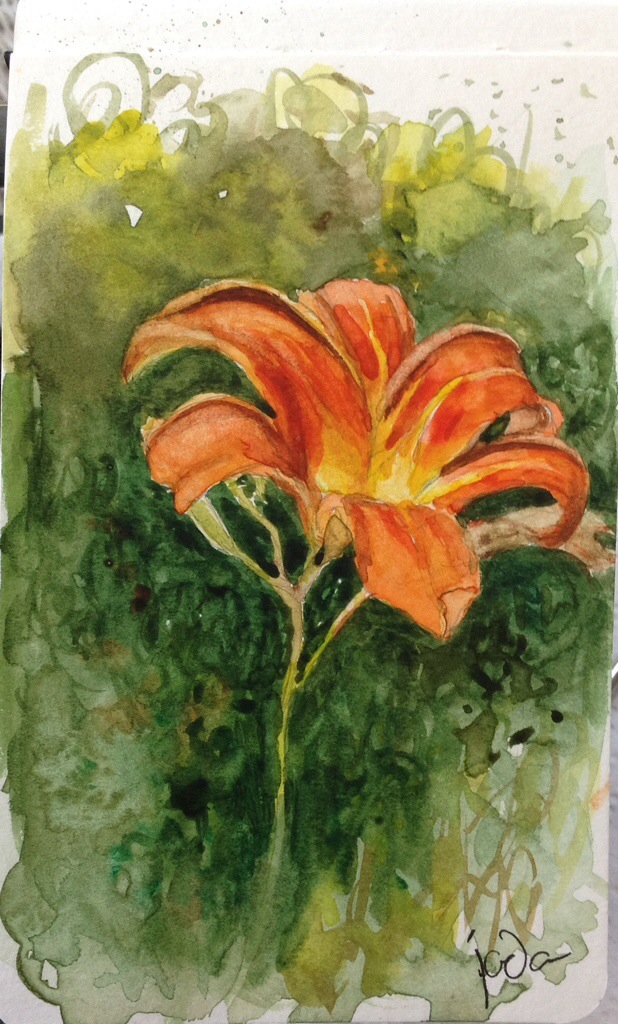
Coming away from hosting a two-day art supplies and equipment yard sale and months of travel and general catching up thereafter, here is this mornings quick watercolor study seen from my porch window…a delaying device before confronting the chaos of a studio which has gone through the torments of multiple changes of organization caused by various art trip requirements and the recent sale…not to mention returning to portraits begun but not completed and overdue as well as several illustration deadlines….
i definitely NEEDED to paint this little day lily (3.5×5.5)….

 THE ART OF JADA ROWLAND